How Did We Get Here?
Evidence from DNA and fine-tuning that points to intelligent design, and what it means to be made in God's image.
The Texas Silver Dollars
Imagine the entire state of Texas—268,596 square miles—covered two feet deep in silver dollars. We’re talking about a staggering number of coins, stretching from the Rio Grande to the Red River, from El Paso to the Gulf Coast. Now imagine marking just one of those coins with a small red dot. Shuffle all of them together. Send someone in blindfolded to walk across this vast sea of silver, reach down at random, and pull out a single coin.
What are the odds they select the marked one?
The number is so small it’s practically meaningless to the human mind—something like one in 10 to the seventeenth power. Your brain simply can’t process probability at that scale. It’s functionally impossible.
Now consider this: that calculation represents the odds of just eight specific prophecies about the Messiah being fulfilled by any single person. Jesus fulfilled over three hundred. The mathematics of prophetic fulfillment alone should leave us speechless before the sovereignty of God.
But here’s what’s remarkable: the precise calibration of the universe’s fundamental constants—the settings that make any form of life possible anywhere—makes the Texas silver dollar scenario look like easy odds. The fine-tuning of the cosmos is so exact, so improbable, so clearly the work of intelligence, that even skeptics have been forced to concede the point.
Fred Hoyle, the astronomer who coined the term “Big Bang” (though he intended it as mockery), confessed: “A common sense interpretation of the facts suggests that a super-intellect has monkeyed with physics, as well as with chemistry and biology.” Anthony Flew, the twentieth century’s most influential philosophical atheist, eventually abandoned atheism primarily because of this evidence, concluding: “A super-intelligence is the only good explanation for the origin of life and the complexity of nature.”
We established in the previous chapter that God exists—that the universe requires a transcendent, eternal, personal Creator to explain its existence. Now we take the next step: How did this Creator bring the universe and humanity into being, and what does that tell us about who we are?
The answer reveals something extraordinary about your identity and value.
The Word Who Creates
The Bible opens with four words that set the stage for everything: “In the beginning, God…” Before matter existed, before time began, before the first particle emerged from nothing—God was already there. The Creator predates and transcends the creation.
But Genesis tells us something even more remarkable about how God created. The pattern repeats throughout chapter one: “And God said… And God said… And God said…” God spoke the universe into existence. Our cosmos is word-based, brought into being through divine speech.
“By the word of the LORD the heavens were made, and by the breath of his mouth all their host” (Psalm 33:6). The galaxies, the nebulae, the countless stars burning across billions of light-years—all of it originated in divine utterance.
This has profound implications. A universe that comes from words implies meaning. Words communicate. Words express intelligence. Words convey purpose. If the universe is word-based, then it is inherently meaningful, not a random concatenation of matter and energy but the expression of a communicating Mind.
But John’s Gospel takes us deeper still:
In the beginning was the Word, and the Word was with God, and the Word was God. He was in the beginning with God. All things were made through him, and without him was not any thing made that was made. In him was life, and the life was the light of men. (John 1:1-4)
The “Word”—the Logos in Greek—isn’t merely a creative utterance. The Word is a person. The Word “was with God” and “was God.” The Word is eternal (“in the beginning”), relational (“with God”), and divine (“was God”). And through this Word, “all things were made.”
Then comes the stunning revelation: “And the Word became flesh and dwelt among us” (John 1:14). The Word is Jesus.
Paul confirms this Christocentric view of creation in Colossians:
For by him all things were created, in heaven and on earth, visible and invisible, whether thrones or dominions or rulers or authorities—all things were created through him and for him. And he is before all things, and in him all things hold together. (Colossians 1:16-17)
Jesus is not merely a teacher, prophet, or moral example who appeared two thousand years ago. Jesus is the eternal Word through whom the Father spoke the universe into existence. The one who walked the dusty roads of Galilee is the same one who ignited the stars.
And notice that final phrase: “in him all things hold together.” The universe doesn’t just owe its origin to Christ; it owes its ongoing existence to him. The forces that bind atoms together, the gravitational relationships that keep planets in orbit, the mathematical constants that govern all physical reality—all of it is sustained moment by moment by the One who made it.
This means that when you study physics, you’re studying Christ’s handiwork. When you marvel at a sunset, you’re seeing Christ’s artistry. When you investigate DNA, you’re reading Christ’s language.
The Argument from DNA
Speaking of language, let’s examine what scientists have discovered inside every cell of your body.
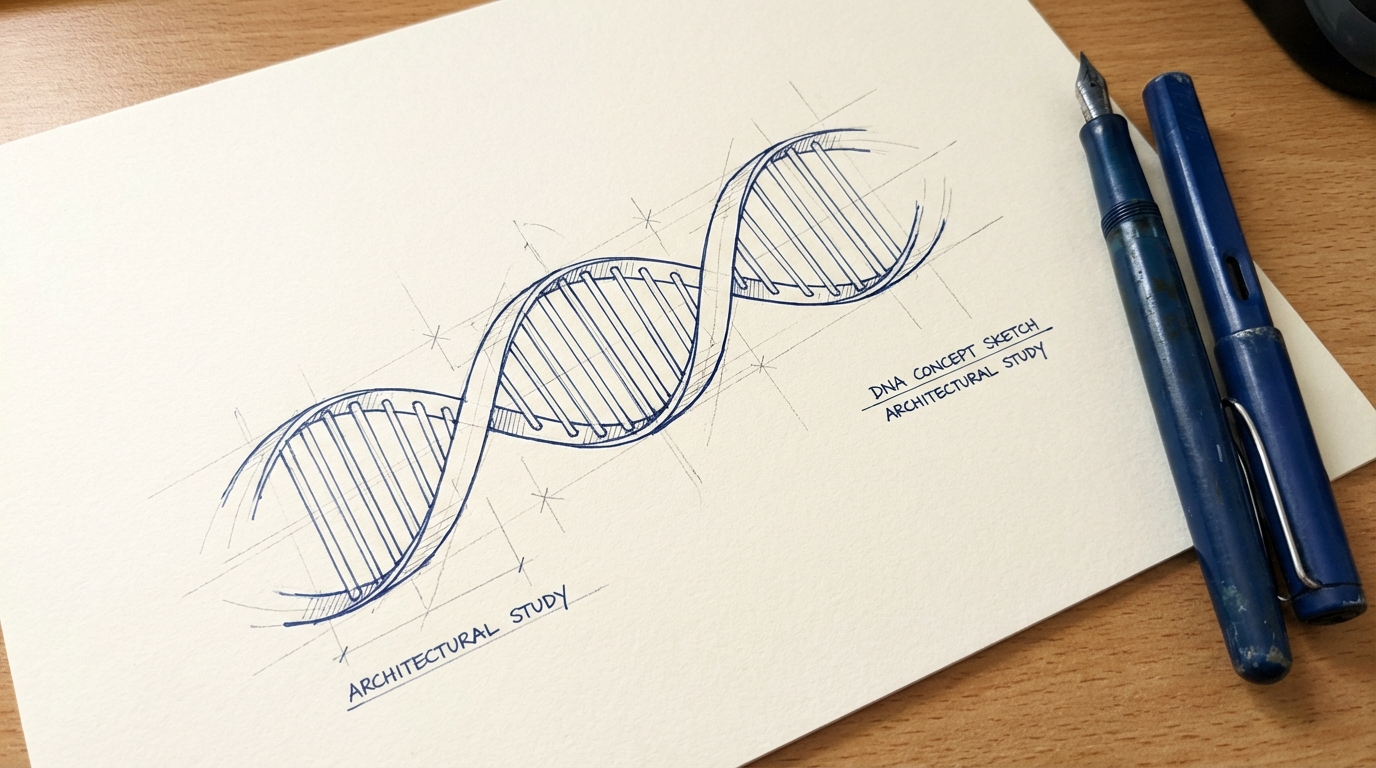
DNA—deoxyribonucleic acid—is often called the “blueprint of life,” but that description understates its sophistication. DNA is not merely a blueprint. DNA is a language.
Consider what defines a language. First, it has syntax—a system of symbols arranged according to rules. Second, it has semantics—the symbols carry meaning beyond their physical properties. Third, it has an encoder and decoder—someone to write the message and someone to read it.
DNA possesses all three characteristics. It uses a four-letter genetic alphabet (adenine, guanine, cytosine, thymine) arranged in precise sequences. These sequences aren’t random; they follow grammatical rules that determine how proteins are built. The sequences carry meaning—they encode instructions that cells read and execute. And the system includes remarkable encoding and decoding mechanisms (RNA transcription and ribosome translation) to process the information.
The result is an information storage system of breathtaking complexity. A single human cell contains approximately three billion base pairs of DNA—three billion letters in a language that, if transcribed, would fill thousands of books. And this isn’t just data; it’s executable code. Your cells read this code and build you from it.
Now here’s the question: Where does language come from?
In all of human experience, language has one and only one source: intelligence. We’ve never observed a language system arise spontaneously from random processes. Languages are created by minds. They require a communicator.
When we send radio signals into space searching for extraterrestrial intelligence, what are we looking for? Not just organized patterns—crystals are organized. We’re looking for information, for sequences that demonstrate semantic meaning and specified complexity. We assume, rightly, that information of this kind requires an intelligent source.
But the information density in DNA dwarfs anything humans have ever created. The coding in your cells is more sophisticated than any programming language Silicon Valley has devised. It includes error-correction algorithms, compression systems, and regulatory mechanisms that computer scientists can only admire.
The DNA in all the cells of your body, if stretched out, would reach to the moon and back approximately 178,000 times. Every moment, that vast library of information is being read, copied, and executed with stunning fidelity.
How did this language originate? The evolutionary paradigm faces a fatal obstacle here. Evolutionary mechanisms—mutation and natural selection—can modify existing living systems. But they cannot explain the origin of life itself, because mutation and selection require a self-replicating system to already be in place. Life cannot evolve until there is life to evolve. The first living cell, with its integrated information processing system, appears in the record without precursors.
Some might say: “Given enough time, couldn’t random processes produce complex information?” But this misunderstands the nature of the problem. Time doesn’t help when you need specified complexity. Throwing dice for billions of years won’t produce Shakespeare. Random letter generation won’t write computer code. The obstacle isn’t patience; it’s probability. The information content of even the simplest self-replicating cell so vastly exceeds what chance processes could produce that “given enough time” becomes a phrase emptied of meaning.
The language encoded in your DNA is far more complex than any menu, any instruction manual, any human text ever composed—and we’re asked to believe it assembled itself by accident?
“I am fearfully and wonderfully made,” wrote the psalmist (Psalm 139:14). Modern genetics has confirmed this ancient declaration beyond anything David could have imagined.
The Fine-Tuning of the Universe
DNA points to design at the cellular level. But the evidence for intelligent creation extends to the cosmic scale as well.
The universe operates according to fundamental constants—numbers built into the fabric of reality that determine how forces behave. The gravitational constant determines how strongly masses attract. The cosmological constant determines the energy density of empty space. The ratio of the mass of protons to electrons determines atomic structure. There are dozens of these constants, and each one has a precise value.
Here’s what scientists have discovered: if any of these constants were even infinitesimally different, the universe would be hostile to any form of physical, interactive life.
Consider the cosmological constant. This value governs the expansion rate of the universe. If it were larger by an almost incomprehensibly small amount (one part in 10^120), the universe would have expanded so rapidly that no stars or galaxies could form. If it were smaller by the same tiny fraction, the universe would have collapsed back on itself almost immediately. The actual value sits in an extraordinarily narrow range that permits structure to exist.
Or consider the strong nuclear force. This force binds protons and neutrons together in atomic nuclei. If it were slightly stronger, hydrogen atoms would fuse too readily, and all hydrogen would have been consumed early in the universe’s history—no water, no organic chemistry, no life. If slightly weaker, nuclei couldn’t form at all. Again, the actual value occupies a razor-thin life-permitting band.
Physicists Roger Penrose calculated that the entropy conditions of the early universe had to be fine-tuned to one part in 10^(10^123)—a number so large that even writing it in standard notation would require more zeros than there are particles in the observable universe.
How do we explain this?
Three options present themselves. First, the fine-tuning could be due to physical necessity—perhaps the constants had to take these values. But there’s no known physical law that requires them to be what they are. They appear contingent, not necessary.
Second, the fine-tuning could be due to chance—we just got lucky. But as we’ve seen, the probabilities involved make this option absurd. Chance explanations work only when the odds are within some reasonable range. When you’re dealing with odds smaller than one in 10^(10^123), “chance” becomes a word without explanatory power.
Third, the fine-tuning could be due to design—a super-intelligence calibrated the constants to permit life. This option doesn’t violate any physical laws. It doesn’t require accepting absurd probabilities. It simply applies the same reasoning we use everywhere else: when we see precise calibration serving a purpose, we infer a calibrator.
Fred Hoyle’s confession bears repeating: “A common sense interpretation of the facts suggests that a super-intellect has monkeyed with physics.” He wasn’t a believer when he said this. He was simply following the evidence.
The universe appears fine-tuned for life because it was fine-tuned for life—by the same Word who spoke it into existence.
Created in God’s Image
The evidence from DNA and fine-tuning establishes that intelligent design pervades creation. But the biblical account makes an even more astonishing claim about humanity specifically.
Then God said, “Let us make man in our image, after our likeness. And let them have dominion over the fish of the sea and over the birds of the heavens and over the livestock and over all the earth and over every creeping thing that creeps on the earth.” So God created man in his own image, in the image of God he created him; male and female he created them. (Genesis 1:26-27)
God picked up dirt, breathed into it, and created the first human being. Then from that human, he fashioned woman. And stepping back from his work, God pronounced it not merely “good” (as he had for the rest of creation) but “very good.”
What does it mean to be made in God’s image?
Theologians have debated this for centuries, but several elements seem clear. Being made in God’s image means we have rational capacity—the ability to think, reason, and communicate. It means we have moral agency—the ability to distinguish right from wrong and make genuine choices. It means we have relational capacity—we are made for communion with God and with each other. It means we have creative capacity—like our Creator, we can bring new things into existence through intention and skill.
But beyond these capacities, being made in God’s image means we have value. Intrinsic, inalienable, sacred value.
Every human being—regardless of age, ability, ethnicity, productivity, or social status—is stamped with the divine image. This is true from the womb to the tomb and everything in between. Every breath of every human being, every beat of every human being’s heart, is a sacred moment. Not because humans earn this status through achievement, but because God conferred it through creation.
This stands in stark contrast to every other worldview’s account of human value.
Secular materialism reduces humans to sophisticated biochemical machines—patterns of matter following deterministic laws. There’s no soul, no inherent worth, no qualitative difference between a person and a rock except complexity. If we’re just matter in motion, then human rights are convenient fictions and human dignity is a useful illusion.
Marxist ideology sees humans primarily through the lens of group identity—oppressor or oppressed, privileged or marginalized. Individual worth becomes subservient to class position. Some people matter more than others depending on which category they occupy. Human value is assigned by political analysis rather than recognized as inherent.
Even Moral Therapeutic Deism, that pseudo-Christianity, makes human value contingent on how we feel about ourselves. You’re valuable because you believe you’re valuable. Your worth depends on your self-perception.
The biblical worldview cuts through all of this. You are valuable because God made you in his image. Full stop. This isn’t negotiable. It doesn’t fluctuate with your performance, your feelings, your social status, or anyone’s opinion of you. You bear the mark of your Maker.
Consider the implications. The unborn child has value—not because of viability or desire, but because of the image. The disabled person has value—not because of productivity, but because of the image. The elderly person has value—not because of utility, but because of the image. The foreigner, the poor, the prisoner, the person whose politics you despise—all bear the image. All possess sacred worth.
This is why Christians throughout history have been at the forefront of establishing hospitals, orphanages, and universities. This is why the Christian worldview has historically elevated the status of women, children, and the vulnerable. This is why followers of Jesus oppose both racism and abortion, both human trafficking and euthanasia. When you understand that every human being is made in God’s image, you cannot remain indifferent to how human beings are treated.
Why This Matters
So what does all of this mean for you?
If secular materialism is true, you’re a cosmic accident—a brief arrangement of atoms that will soon dissolve back into the void. Your intuitions about meaning, purpose, and value are evolutionary illusions, useful perhaps for survival but ultimately disconnected from reality. Make the best of your brief flicker of existence, but don’t pretend it signifies anything.
If the biblical worldview is true, you are the intentional creation of an intelligent, loving Creator. You were designed on purpose, with purpose. The same Word who calibrated the universal constants and encoded DNA also formed you, knows you, and values you infinitely.
Your worth is not earned. It was given.
Your existence is not accidental. It was planned.
Your life is not meaningless. It was intended.
The Maker of galaxies stooped to make you. The One who sustains solar systems also sustains your heartbeat. You are not a random collocation of molecules. You are fearfully and wonderfully made—knit together by sacred hands, stamped with the divine image, declared very good by the Author of existence.
This truth should reorient everything. How you view yourself. How you view others. How you make decisions about ethics and relationships and the use of your time. If you are made in God’s image, then you have dignity that nothing can revoke and a purpose that extends beyond the grave.
God created everything good. He created humans in his image. So why does the world look nothing like “very good”? Why is creation scarred by suffering, injustice, and death? If we were made for paradise, why do we live in a war zone?
What went wrong? That’s the question we must answer next.
Reflection Questions
-
The fine-tuning argument suggests the universe appears calibrated for life. Before encountering this evidence, how did you think about why the universe seems hospitable to human existence?
-
DNA is described as a language—with syntax, semantics, and encoding/decoding systems. What does the presence of language in biology suggest about its origin?
-
Being made in God’s image is said to give humans inherent, inalienable worth. How does this differ from how secular culture typically grounds human value? What practical difference does it make?
-
If Jesus is the Word through whom all things were created and in whom all things hold together (John 1:3, Colossians 1:17), how should this affect how you view the physical world around you?
-
The chapter ends by noting the tension between being created “very good” and the brokenness we observe everywhere. How do you currently explain this discrepancy?
Key Takeaways
-
The universe was spoken into existence by God through the eternal Word, who is identified in Scripture as Jesus Christ—creation is word-based, meaningful, and intentional.
-
DNA functions as a language with syntax, semantics, and processing mechanisms. Languages come only from intelligent minds, pointing to an intelligent Author of life.
-
The fine-tuning of the universe’s fundamental constants is so precise and improbable that even skeptical scientists acknowledge it suggests a “super-intelligence” behind reality.
-
Being made in God’s image gives every human being—from conception to natural death—intrinsic, sacred value that is not earned through performance but conferred through creation.
-
If we are intentionally designed by a loving Creator, our worth is secure, our existence is meaningful, and our purpose extends beyond ourselves—a stark contrast to materialistic accounts that reduce us to cosmic accidents.